
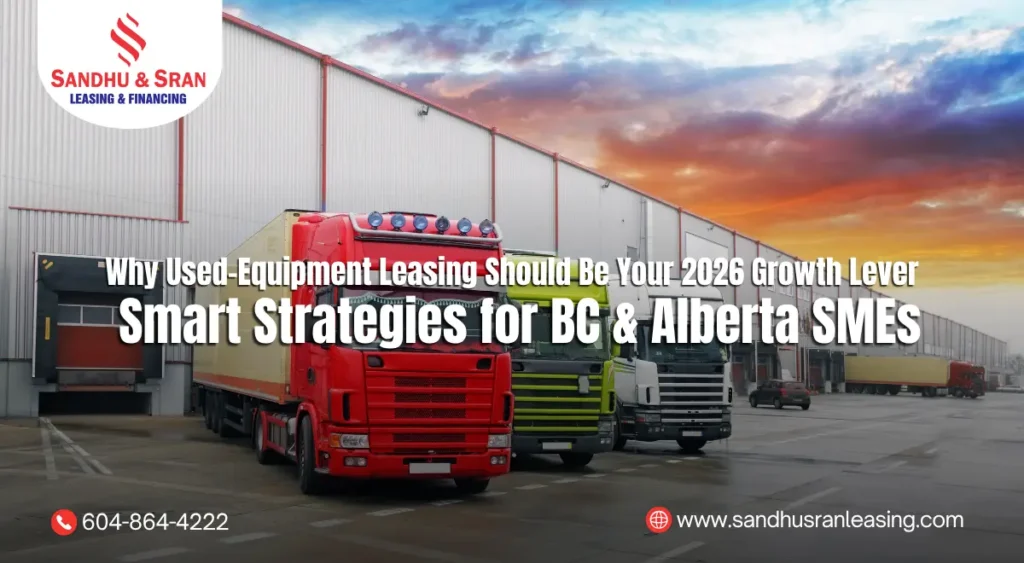
Capital Efficiency Is the New Growth Currency
Canada’s small and mid-sized businesses are entering 2026 with cautious optimism.
After the Bank of Canada’s October 2025 rate cut to 2.25 percent, borrowing conditions have improved — but the landscape has changed. Equipment prices remain high, credit scrutiny persists, and cash flow has become the ultimate benchmark of strength.
In this environment, used-equipment leasing has quietly emerged as a strategic growth lever.
It gives businesses across Abbotsford, Surrey, and Edmonton the power to expand capacity, replace aging assets, and embrace sustainability — all without draining capital reserves.
Where traditional purchasing locks funds into depreciating machinery, used-equipment leasing turns flexibility and affordability into competitive advantage.
What Exactly Is Used-Equipment Leasing?
Used-equipment leasing allows companies to lease pre-owned, professionally serviced assets — such as construction loaders, semi-trucks, trailers, or farm machinery — through structured financing agreements.
Unlike short-term rentals, these leases are designed for consistent operational use, often spanning 24 to 48 months.
The model works particularly well for sectors that rely on durable assets with long service lives: construction, logistics, manufacturing, and agriculture.
Because the asset has already experienced its steepest depreciation, payments are significantly lower — often 25–35 percent less than new-equipment leases.
For many SMEs, that difference can translate into hundreds of thousands of dollars in liquidity over a three-year period.
You can explore similar financing models on our Equipment Financing and Commercial Leasing pages.
Why Used Assets Are Becoming the Smart Choice
Until recently, buying new was seen as the only “serious” investment.
But the 2024–25 cycle shifted that perception. Longer supply chains, tighter margins, and higher insurance costs have made pre-owned equipment more desirable than ever.
According to IBISWorld’s Industrial Equipment Leasing Report (2025), demand for used-equipment financing rose nearly 18 percent year-over-year — driven largely by SMEs aiming to expand under cost pressure.
Key reasons driving this momentum:
- Predictable performance: High-quality used equipment, typically 2–4 years old, offers nearly identical operational efficiency with lower risk.
- Stabilized residual values: Depreciation slows after the initial ownership period, giving SMEs better end-of-term options.
- Availability: Unlike new assets, used inventory can be delivered quickly — vital when projects start on short notice.
In regions like BC and Alberta, where industries such as construction and trucking dominate, these advantages aren’t theoretical — they’re practical.
A Surrey-based earthmoving contractor leasing pre-owned excavators can start a new municipal project within weeks instead of waiting months for factory delivery.
Similarly, an Edmonton freight operator can expand fleet capacity using well-maintained, second-owner trailers at a fraction of the cost.
Five Business Advantages of Used-Equipment Leasing
1. Lower Monthly Costs, Higher Profit Margins
Since used assets come at reduced market value, lease payments are significantly lighter.
This directly boosts cash flow — allowing funds to be redirected toward hiring, materials, or marketing.
2. Faster Approvals, Easier Terms
Used-equipment leases typically carry smaller exposure for lenders, enabling faster approval cycles and greater flexibility for SMEs with limited or uneven credit histories.
For businesses rebuilding credit, this can be a strategic stepping-stone toward future expansion.
3. Full Tax Deductibility
Lease payments are treated as operational expenses, not capital assets — simplifying accounting and offering tax-efficient deductions each year.
4. Sustainability and Circular Economy Value
Re-using existing equipment reduces manufacturing demand and carbon output.
In the age of ESG accountability, choosing used assets sends a clear message of environmental responsibility — without sacrificing productivity.
5. Stronger Liquidity and Risk Management
Because ownership risk (depreciation, resale uncertainty) sits with the lessor, the business can maintain healthier liquidity ratios — crucial for attracting investors or tendering large contracts.
Industry Spotlight: Who’s Leading the Shift
Construction:
Across BC’s Lower Mainland, developers are adopting mixed fleets of new and used machinery to hedge costs. Compact loaders and backhoes under three years old can deliver the same output while reducing monthly financing by 30 percent.
Transportation & Logistics:
Used semi-trucks and refrigerated trailers are the backbone of Alberta’s mid-sized carriers. With the BoC’s latest rate adjustment and stable fuel costs, leasing pre-owned fleets helps operators expand capacity without long-term debt exposure.
Agriculture & Agri-Processing:
Farmers in the Fraser Valley and Edmonton outskirts are leasing pre-owned harvesters and tractors to manage seasonal workloads. The strategy helps balance high equipment demand during harvest with idle-season cash-flow discipline.
Manufacturing:
For fabrication shops and local production units, used CNC machines or packaging systems offer modern capability at half the cost of new imports — helping preserve competitive pricing amid rising material costs.
A Smarter Strategy: Combine Used Leasing with Trade-Ins
One of the most effective ways to maximize return is to combine used-equipment leasing with trade-ins or lease buyouts.
For instance, a Surrey-based trucking company can trade two older units toward a newer, used fleet under one consolidated lease line — lowering down payments and simplifying monthly accounting.
This approach improves asset turnover and keeps operating fleets current without a heavy capital draw.
Managing Quality and Reliability
The key to success with used-equipment leasing lies in quality control and reputable sourcing.
Always ensure that the lessor verifies:
- Full maintenance and service records,
- Certified refurbishments or pre-delivery inspections, and
- Warranty coverage for critical components.
At Sandhu & Sran Leasing & Financing, our partner network ensures every leased unit meets operational and safety standards — giving clients peace of mind while enjoying the savings of pre-owned value.
Designing a Smarter Leasing Strategy for 2026
Used-equipment leasing is not just about finding a lower monthly payment — it’s about structuring the lease in a way that aligns with your operations, cash cycles, and asset usage.
The most successful SMEs across BC and Alberta treat leasing as a strategic planning tool. Here’s how to build that mindset into your 2026 plan:
1. Match Lease Terms to Project Lifecycles
If a construction or transport contract runs for two years, choose a lease term that mirrors that timeframe. This ensures payments align directly with project revenue and avoids excess liability after project completion.
2. Consider Residual Value Options
Used-equipment leases often offer flexible buyout clauses. Discuss a fair-market-value purchase option or a guaranteed residual to protect cash flow when upgrading later.
3. Track Utilization and Maintenance Data
Integrating telematics or IoT tracking helps document usage hours and condition, simplifying negotiations at lease-end and qualifying you for lower renewal rates.
4. Bundle Multiple Assets Under One Lease Line
Instead of managing separate contracts for each machine or truck, consolidate them into a commercial lease line. It simplifies approvals and cash-flow planning — a service Sandhu & Sran Leasing & Financing offers through its Commercial Leasing programs.
5. Evaluate Lessor Reputation and Refurbishment Quality
Used-equipment leases vary widely in quality. Partner only with financing advisors who verify maintenance records, inspect refurbishment standards, and provide transparent condition reports.
Understanding the 2026 Market Outlook
The Canadian economy is stabilizing but far from fully recovered. According to the Bank of Canada’s Monetary Policy Report, GDP growth is projected at 1.1 percent in 2026, signaling modest expansion after a slow 2025.
In this environment, capital discipline will define success:
- Interest Rates: With the BoC rate at 2.25 percent, borrowing is more affordable than during 2023-24, but banks remain cautious with unsecured credit.
- Equipment Demand: Construction and logistics activity in Western Canada is rebounding, especially around Surrey’s industrial corridors and Edmonton’s distribution hubs.
- Used Asset Pricing: After years of volatility, the used-equipment market has stabilized, providing predictable valuations and favorable lease-to-value ratios.
These trends make early 2026 an opportune time for SMEs to lock in competitive used-leasing contracts before demand surges again.
Tax and Accounting Considerations
Used-equipment leases offer several financial advantages often overlooked:
- Operational Expense Treatment: Monthly lease payments are fully deductible as operating expenses, simplifying bookkeeping and preserving borrowing power.
- GST/PST Treatment: Taxes apply only to monthly payments, not to the full asset value upfront, easing cash-flow strain.
- Residual Flexibility: Since used assets depreciate more slowly, end-of-lease residuals can be renegotiated or rolled into new contracts with minimal adjustment.
Many SMEs also combine lease buyouts and trade-ins at renewal to keep their fleet current while avoiding the tax implications of outright ownership.
ESG and Sustainability Benefits
Environmental responsibility is now a tender-qualification factor in many public and private contracts. Leasing used assets supports circular-economy principles by extending equipment life and reducing production waste.
For example, replacing an aging diesel excavator with a refurbished hybrid under a used-lease structure can cut operating emissions by 20–25 percent while keeping costs down.
This dual benefit — lower carbon, lower cost — helps SMEs align with CleanBC initiatives and Alberta’s ESG reporting trends.
Case Study: Rebuilding Fleet Capacity in Surrey
A Surrey-based freight operator faced capacity constraints in mid-2025. Instead of taking on new-truck loans, the company worked with Sandhu & Sran Leasing & Financing to lease five pre-owned refrigerated trailers.
Each unit came with service documentation and residual flexibility. Within six months, operating costs dropped 22 percent and average delivery capacity rose 15 percent — proof that strategic used-leasing can drive both financial and operational results.
The Sandhu & Sran Difference
Leasing used equipment requires more than numbers — it requires trust, insight, and a network of verified partners.
As your equipment funding expert, Sandhu & Sran Leasing & Financing helps businesses in Abbotsford, Surrey, and Edmonton:
- Assess used-asset quality before signing,
- Structure leases that fit project timelines and budgets, and
- Simplify renewals, upgrades, or buyouts through a single financing channel.
By blending industry knowledge with flexible funding structures, we help Canadian SMEs grow smarter — not riskier.
Learn more about our Equipment Financing and Truck Loans solutions designed for evolving small-business needs.
2026: A Year to Grow Without Overstretching
With moderate rates, steady demand, and greater emphasis on sustainability, 2026 marks a turning point for capital investment in Canada.
Used-equipment leasing offers an ideal way for small businesses to:
- Scale operations without heavy debt,
- Keep fleets and machinery current,
- And maintain cash reserves for growth.
In a market where resilience beats aggression, flexibility beats ownership.
Used-equipment leasing delivers both.
Frequently Asked Questions
1. Is leasing used equipment as reliable as new?
Yes — when leased through verified financing partners, used assets undergo inspection, servicing, and certification before delivery. Operational performance is often within 5–10 percent of new models.
2. Can I qualify for a used-equipment lease with bad credit?
Absolutely. Many clients with imperfect credit histories qualify for used-asset leases because the equipment itself serves as collateral.
3. How much can I save by leasing used equipment instead of new?
On average, monthly payments are 25–35 percent lower for used assets, depending on age, model, and condition.
4. Can I trade or upgrade before my lease term ends?
Yes. With structured buyout clauses, you can trade existing leased units toward newer used or refurbished equipment — an option many BC and Alberta clients now use to stay competitive.
5. Are used-equipment leases tax-deductible?
Yes. All payments are typically 100 percent deductible as operating expenses, offering a cleaner balance-sheet position compared to outright ownership.
Closing Thought
For SMEs in Abbotsford, Surrey, and Edmonton, 2026 is the time to rebuild efficiently — not expensively.
Used-equipment leasing offers access, affordability, and adaptability — the three ingredients every growth-minded business needs to thrive in the next economic cycle.
If you’re planning to expand, replace, or modernize your fleet or machinery, connect with Sandhu & Sran Leasing & Financing — your local partner for smarter, faster, and more flexible equipment funding.
📞 +1 604-864-4222
🌐 sandhusranleasing.com

