
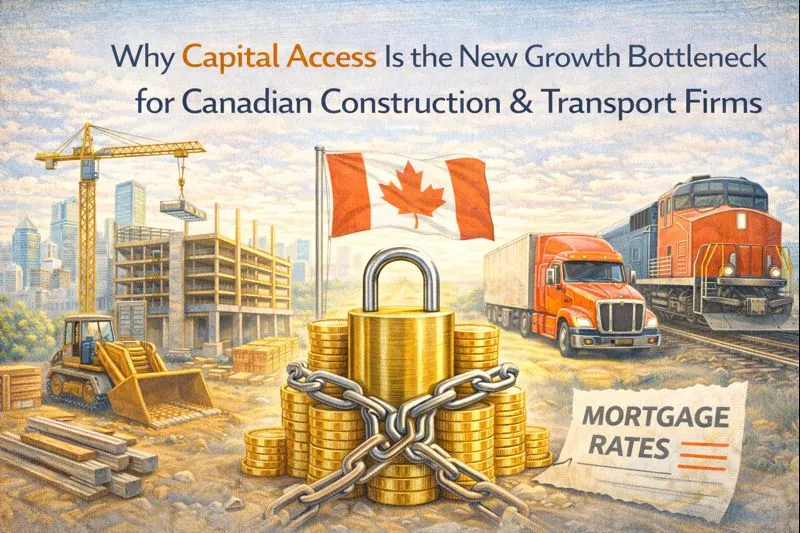
Across Canada, construction companies and transport operators are experiencing a paradox. On one hand, demand for:
- Infrastructure projects
- Residential and commercial development
- Freight movement and logistics
- Public transit and municipal contracts
is growing steadily.
On the other hand, capital access remains the single greatest growth constraint.
Firms are asset-rich but cash-constrained. Millions of dollars sit locked inside:
- Fleet vehicles
- Heavy equipment
- Trailers
- Cranes
- Excavators
- Loaders
- Specialized industrial machinery
This is where sale-leaseback financing has emerged as one of the most powerful financial tools for Canadian construction and transport firms between 2025 and 2027.
Instead of borrowing new money or selling equipment permanently, sale-leaseback allows businesses to:
- Convert owned equipment into immediate operating capital
- Keep using the same assets without disruption
- Stabilize cash flow
- Fund expansion without traditional loans
- Preserve credit capacity
This guide explains exactly how it works, when it makes sense, and how Canadian businesses are using it as a strategic growth weapon.
What Is a Sale-Leaseback?
A sale-leaseback is a financing structure where a business:
- Sells an owned asset (truck, equipment, fleet, machinery)
- Receives a lump-sum cash payment immediately
- Leases back the same asset under a fixed monthly payment
- Continues using the asset without interruption
In simple terms:
You sell what you already own to unlock cash — then lease it back to keep operating as usual.
This transforms a “dead asset” on the balance sheet into live working capital.
Why Sale-Leasebacks Are Surging in Canada (2025–2027)
Several major economic forces are driving explosive adoption:
1. Infrastructure & Housing Construction Boom
Federal and provincial governments are injecting massive funding into:
- Affordable housing
- Transportation corridors
- Transit expansions
- Utilities and public works
Contractors need fast capital to scale equipment capacity.
2. Freight & Logistics Expansion
E-commerce, cross-border trade, and regional distribution growth have increased pressure on:
- Owner-operators
- Mid-sized fleet businesses
- Last-mile delivery firms
Sale-leasebacks free up capital for:
- Fleet expansion
- Driver hiring
- Fuel hedging
- Warehouse deposits
3. Bank Lending Tightening
Traditional banks remain conservative in:
- Truck financing
- Used equipment lending
- Thin-credit commercial borrowers
- Seasonal revenue businesses
Sale-leasebacks bypass rigid bank lending criteria using asset-backed underwriting.
4. Equipment Prices at All-Time Highs
Excavators, loaders, cranes, and heavy transport equipment have risen sharply in price. This increases the equity value of already-owned assets, making sale-leasebacks more powerful than ever.
What Assets Qualify for Sale-Leaseback in Canada?
Most commercial, titled, and high-value movable assets qualify, including:
Construction Assets
- Excavators
- Backhoes
- Skid steers
- Dozers
- Wheel loaders
- Cranes
- Concrete pumps
- Compactors
Transport & Logistics Assets
- Highway tractors
- Box trucks
- Reefers
- Flatbed trailers
- Tankers
- Dump trucks
- Vans
Industrial & Specialty Equipment
- Manufacturing equipment
- Material handling machinery
- Forklifts & racking systems
- Power generation units
How Sale-Leaseback Unlocks Capital Without Debt Pressure
Traditional borrowing adds:
- New debt
- Credit utilization
- Approval friction
- Long underwriting delays
Sale-leaseback instead:
- Converts your existing asset into liquid capital
- Does not require new collateral
- Preserves revolving credit lines
- Avoids dilution of ownership
- Keeps debt ratios balanced
Most importantly: it does not interrupt operations.
Real-World Cash Uses for Sale-Leaseback Funds
Canadian construction and transport firms are using sale-leaseback proceeds to:
- Fund project mobilization deposits
- Cover payroll expansion
- Add subcontractors
- Secure fuel contracts
- Purchase additional used equipment
- Expand into new territories
- Meet insurance reserve requirements
- Invest in digital dispatch & telematics
- Finance EV or low-emission fleet transition
Cash Flow Stability Through Predictable Leasing
Once transformed into a lease:
- Payments become predictable
- Budget forecasting becomes accurate
- Cash volatility reduces
- Seasonal revenue alignment becomes possible
Many programs support:
- Deferred initial payments
- Seasonal payment structures
- Balloon end-of-term options
This is crucial for:
- Winter-affected construction
- Seasonal freight
- Agricultural transport
Sale-Leaseback vs Traditional Equipment Loan
| Feature | Traditional Loan | Sale-Leaseback |
| Requires New Asset | Yes | No |
| Unlocks Current Asset Value | No | Yes |
| Adds New Debt | Yes | Minimal |
| Cash Injection | Limited | Immediate |
| Approval Based on Credit | Heavy | Asset-Focused |
| Operational Disruption | Possible | None |
| Speed of Funding | Slow | Fast |
Why Sale-Leasebacks Are Perfect for Credit-Constrained Businesses
Many firms face:
- Thin credit
- Past cyclical downturns
- Seasonal cash volatility
- High equipment exposure
Sale-leaseback approvals rely primarily on:
- Asset condition
- Market resale value
- Proven operating cash flow
- Maintenance history
This levels the playing field for:
- Owner-operators
- Family-run contractors
- Immigrant-owned businesses
- Growth-stage fleets
The Hidden Tax Advantage of Sale-Leasebacks
After converting to a lease:
- Monthly lease payments become tax-deductible operating expenses
- Depreciation complexity disappears
- Accounting becomes simpler
- Cash tax savings improve annually
Many Canadian firms discover they:
- Recover tax efficiency lost during owned-asset depreciation
- Improve EBITDA predictability
Sale-Leaseback in the Age of Equipment Depreciation Risk
Modern construction and transport equipment depreciates faster due to:
- Automation
- Emissions technology
- Digital control systems
- Rapid regulatory change
By leasing instead of holding:
- Residual-value risk shifts to the lessor
- Obsolescence exposure is reduced
- Upgrade paths remain flexible
EV & Clean Transport Transition Through Sale-Leaseback
Many fleet owners use sale-leasebacks to:
- Unlock capital from diesel fleets
- Fund EV trucks and charging infrastructure
- Transition to low-emission transport without new borrowing
This aligns perfectly with Canada’s:
- Clean transport mandates
- Carbon reduction incentives
- Municipal fleet compliance requirements
Common Sale-Leaseback Mistakes to Avoid
- Undervaluing equipment
- Choosing rigid lease terms
- Ignoring seasonal revenue patterns
- Over-extending lease length
- Using one lender instead of multiple options
- Failing to include fleet bundling
Professional structuring prevents these errors.
When Sale-Leaseback Is NOT the Right Solution
Although powerful, it is not ideal when:
- Equipment is near end-of-life
- Maintenance costs exceed lease value
- Revenue is unproven or unstable
- Ownership provides regulatory licensing advantage
- Asset resale market is limited
Strategic assessment must precede execution.
Why 2025–2027 Creates a Perfect Storm for Sale-Leasebacks
Three major forces peak simultaneously:
- High resale equipment values
- Credit constraint on traditional loans
- Expansion projects across construction and logistics
This combination makes sale-lease backs one of the highest-impact financial strategies available to Canadian operators right now.
Frequently Asked Questions (FAQs)
Is sale-leaseback legal in Canada?
Yes. It is a widely recognized and regulated commercial financing structure used across multiple industries.
Can I sell and lease back multiple assets at once?
Yes. Fleet and equipment bundling is common and often improves payout and terms.
How fast can funding happen?
Some structured deals fund within days once valuation and documentation are completed.
Does sale-leaseback affect ownership control?
You retain full operational control of the equipment during the lease.
Can sale-leaseback improve my credit profile?
Yes. It often improves liquidity ratios and reduces short-term debt burden.
Final Takeaway for Construction & Transport Firms in Canada
In today’s high-demand, capital-intensive economy, the fastest-growing firms are not those with the largest fleets — but those with the smartest capital structures.
Sale-leasebacks allow Canadian construction and transport firms to:
- Monetize what they already own
- Scale faster than competitors
- Stabilize cash flow
- Protect credit capacity
- Upgrade fleets strategically
- Enter new projects without hesitation
This is not emergency financing — it is strategic capital engineering.
Call to Action (CTA)
If your construction company, transport fleet, or contracting business holds valuable equipment but faces cash constraints, a professionally structured sale-leaseback can immediately unlock growth.
Sandhu & Sran Leasing & Financing helps Canadian businesses:
- Execute sale-leasebacks on trucks, fleets & equipment
- Secure maximum fair-market asset value
- Customize seasonal lease payments
- Reinvest into project growth immediately
- Transition into EV & clean-transport fleets
- Secure approvals even with complex credit profiles
👉 Book your confidential sale-leaseback consultation today:
https://www.sandhusranleasing.com

