
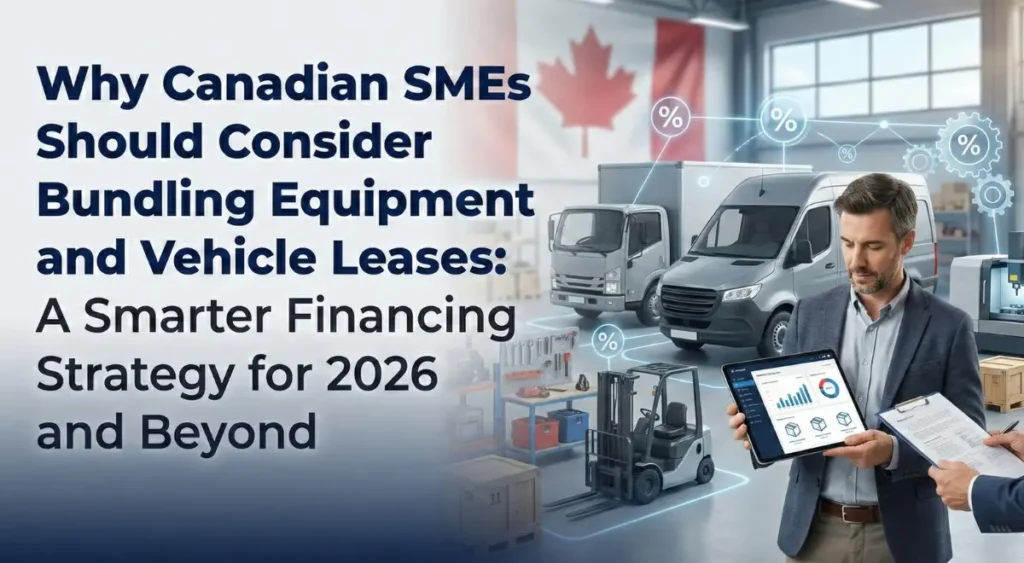
Canadian small and medium-sized enterprises (SMEs) are facing a new operating reality. Between persistent inflation, interest-rate normalization, supply-chain volatility, labour shortages, clean-tech mandates, and digital transformation, running a business in 2026 is more capital-intensive than ever before.
Trucks, vans, construction equipment, manufacturing machinery, IT systems, warehouse automation, refrigeration units, and even EV charging infrastructure are now all essential for competitiveness. Yet financing each asset separately is no longer efficient.
That’s why a fast-growing number of Canadian SMEs are adopting a bundled leasing strategy — where multiple assets (vehicles + equipment + infrastructure) are financed under a single, unified lease structure.
Instead of managing five different loans, approvals, payment schedules, and renewal cycles, bundled leasing offers:
- One approval
- One payment structure
- One financing partner
- One predictable cash-flow plan
- One integrated growth strategy
This blog explains:
- What bundled leasing really is
- Why it’s rapidly gaining traction in Canada
- How it improves cash flow and approvals
- Which industries benefit most
- The financial, tax, and operational advantages
- What Canadian SMEs should consider in 2026 and beyond
What Is Bundled Leasing?
Bundled leasing is a financing structure where a business combines multiple assets into a single lease agreement rather than financing each item separately.
A bundled lease may include:
- Commercial vehicles (vans, trucks, fleet vehicles)
- Heavy construction equipment
- Manufacturing or processing machines
- Material handling systems (forklifts, racking)
- Technology systems (POS, servers, automation)
- Refrigeration and cold-storage units
- EV charging infrastructure
- Specialty tools and attachments
All of these assets are then financed under:
- One approval
- One monthly payment
- One lease term
- One renewal or upgrade cycle
Instead of fragmented financing, your entire operational backbone becomes part of one cohesive financial structure.
Why Bundled Leasing Is Exploding in Popularity Across Canada
Several forceful market shifts are driving this trend.
1. Equipment & Vehicle Prices Have Reset Higher
Since 2020, commercial asset pricing has structurally moved upward:
- Trucks cost more
- Equipment costs more
- Automation systems cost more
- Installation costs more
Bundling multiple assets helps SMEs:
- Spread cost across a larger lease portfolio
- Obtain better blended pricing
- Avoid repetitive down payments
2. Business Operations Have Become More Interconnected
A modern SME no longer functions on a single asset category:
- A logistics firm needs trucks + scanners + warehouse racking
- A construction company needs loaders + trailers + telematics
- A food processor needs refrigeration + conveyors + packaging lines
- A retailer needs delivery vans + POS + security systems
Bundled leasing reflects how businesses actually operate as integrated systems.
3. Credit Conditions Reward Consolidation
Lenders now favour:
- Larger total financing values
- Diversified asset risk
- Stable blended cash-flow models
- Strong asset mix collateral
A bundled lease often approves more easily than multiple small standalone deals, especially for:
- Thin-credit SMEs
- Growing contractors
- New incorporations
- Seasonal businesses
4. Digital Financing Platforms Prefer Multi-Asset Structures
Digital underwriting systems now evaluate:
- Entire operational ecosystems
- Cash-flow across asset groups
- Fleet + equipment interaction
Bundling actually improves automated risk scoring.
How Bundled Leasing Improves Cash Flow for Canadian SMEs
Cash flow is the lifeblood of SMEs. Bundled leasing directly improves it in five critical ways:
1. Lower Combined Monthly Payments
Rather than stacking separate high-interest payments, bundling allows:
- Blended pricing
- Longer amortization tailoring
- Lower average monthly burden
2. Reduced Upfront Capital Requirements
Instead of multiple deposits for different assets, businesses often require:
- One reduced down payment
- Or none at all, depending on structure
3. Unified Budget Forecasting
With one predictable payment:
- Forecasting becomes accurate
- Seasonal planning becomes simpler
- Cash buffers become more reliable
4. Revenue Alignment
Bundled leases can be customized to:
- Match delivery cycles
- Align with project billing
- Reflect seasonal demand
- Adjust during ramp-up phases
5. Less Administrative Leakage
Multiple loan structures cause:
- Payment errors
- Missed auto-drafts
- Accounting reconciliation issues
- Audit complications
Bundling eliminates this friction.
Approval Advantages: Why Bundled Leasing Often Gets Approved When Standalone Deals Do Not
Many Canadian SMEs struggle with:
- Thin business credit
- New incorporations
- Prior pandemic disruptions
- Inconsistent seasonal revenue
- High equipment concentration
Bundled leasing improves approvals by:
- Spreading risk across multiple asset categories
- Reducing lender dependence on a single piece of collateral
- Improving overall asset recovery profiles
- Enhancing cash-flow stress testing
For example:
A standalone truck lease might be declined.
A truck + refrigeration + POS + warehouse equipment bundle might be approved.
Risk diversification unlocks capital.
Tax Efficiency of Bundled Leasing in Canada
In most commercial scenarios:
- Bundled lease payments are treated as operating expenses
- Payments remain fully deductible (subject to CRA rules)
- No complex depreciation tracking is required
- Capital cost allowance (CCA) accounting becomes simplified
Instead of tracking:
- Multiple depreciation schedules
- Different asset classes
- Variable residual assumptions
Your accounting remains clean and predictable.
Operational Advantages of Bundled Equipment & Vehicle Leasing
1. Unified Upgrade Cycles
All assets refresh together every 3–5 years instead of on scattered timelines.
2. Predictable Technology Roadmap
Digital systems, vehicles, and automation can be upgraded simultaneously.
3. Reduced Obsolescence Risk
Assets are no longer stranded while waiting for unrelated upgrades.
4. Centralized Fleet & Asset Management
Maintenance, insurance, and monitoring become integrated.
Which Canadian Industries Benefit the Most from Bundled Leasing?
Transport & Logistics
- Trucks
- Trailers
- Telematics
- Scanners
- Warehouse racking
Construction & Contracting
- Loaders
- Excavators
- Compressors
- Utility trailers
- Digital safety systems
Manufacturing & Processing
- CNC machines
- Robotics
- Packaging equipment
- Cold storage
- Material handling
Food & Beverage
- Refrigeration
- Processing lines
- Delivery vans
- POS
- Cold-chain tracking
Agriculture
- Tractors
- Harvesters
- Irrigation systems
- Precision sensors
Healthcare & Services
- Mobile service vans
- Diagnostic equipment
- IT infrastructure
Bundled Leasing vs Separate Financing: A Strategic Comparison
| Feature | Separate Loans | Bundled Leasing |
| Approvals | Multiple | One |
| Cash Flow | Fragmented | Unified |
| Deposits | Multiple | One |
| Risk Exposure | Concentrated | Diversified |
| Accounting | Complex | Simplified |
| Upgrade Planning | Disjointed | Coordinated |
| Lender Relationship | Fragmented | Strategic |
The Role of Bundled Leasing in Clean-Tech & EV Transitions
As businesses transition to:
- Electric fleets
- Charging stations
- Battery storage
- Energy-efficient machinery
Bundled leasing allows:
- EVs + chargers + power upgrades in a single structure
- Incentives applied across the entire bundle
- Infrastructure costs amortized with fleet savings
- Carbon compliance planned holistically
This avoids isolated EV purchases that strain cash flow.
Common Bundled Leasing Mistakes to Avoid
- Bundling assets with mismatched useful life cycles
- Overloading early-stage businesses with too many assets at once
- Ignoring seasonal revenue curves
- Underestimating installation and integration costs
- Failing to bundle digital systems with physical equipment
- Choosing rigid lease terms without renewal flexibility
Professional structuring is essential.
When Bundled Leasing Is Not the Best Option
Bundling may not be ideal when:
- A business only needs one asset
- Usage is extremely short-term
- The equipment is highly experimental
- Regulatory life is uncertain
- Cash reserves are sufficient for ownership
However, even in these cases, hybrid models often outperform isolated financing.
How Bundled Leasing Supports Growth, Not Just Acquisition
Bundled leasing allows SMEs to:
- Launch new service lines
- Open new locations
- Expand fulfillment capacity
- Accelerate automation
- Transition to low-emission fleets
- Handle multi-year contracts confidently
Instead of reacting to growth, businesses finance forward.
The 2026–2030 Outlook for Bundled Commercial Leasing in Canada
Expect:
- Higher multi-asset financing programs
- Greater EV + infrastructure bundling
- AI-driven asset group underwriting
- Usage-based lease models
- Embedded insurance and maintenance
- Cross-provincial asset financing
Bundled leasing will become the dominant commercial financing model for SMEs.
Frequently Asked Questions (FAQs)
Does bundled leasing cost more than separate financing?
No. Bundling typically reduces overall cost through blended pricing and reduced administrative load.
Can used equipment and new vehicles be bundled together?
Yes. Many programs support mixed asset age bundles.
Can seasonal businesses bundle leases?
Yes. Payments can be customized to match revenue cycles.
Is bundled leasing harder to exit early?
Not necessarily. Professional structuring includes early-exit protection and upgrade paths.
Can startups qualify for bundled leasing?
Yes. Asset-backed underwriting often supports new businesses better than traditional loans.
Final Takeaway for Canadian SMEs
In 2026 and beyond, growth will not be limited by ambition — it will be limited by how intelligently capital is structured.
Bundled equipment and vehicle leasing allows Canadian SMEs to:
- Control costs
- Simplify operations
- Improve approval strength
- Scale infrastructure faster
- Reduce obsolescence risk
- Preserve cash for strategic growth
It is no longer just a financing method — it is a competitive infrastructure strategy.
Call to Action (CTA)
If your business is expanding fleets, adding equipment, upgrading infrastructure, or transitioning into EV and automation systems, bundling your assets into one smart lease structure can unlock immediate financial efficiency.
Sandhu & Sran Leasing & Financing helps Canadian SMEs:
- Bundle trucks, equipment, and infrastructure into one approval
- Customize seasonal and growth-aligned payment structures
- Secure approvals even with thin or evolving credit profiles
- Integrate EV fleets with charging and power upgrades
- Replace fragmented loans with strategic multi-asset leasing

