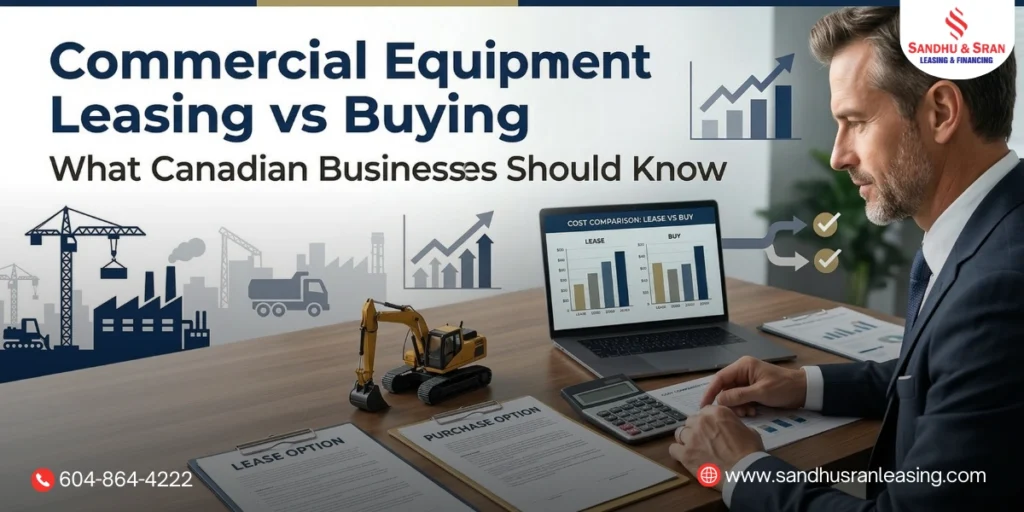
Every growing business eventually faces an important decision: should you lease equipment or buy it outright?
From construction machinery and commercial trucks to manufacturing equipment and agricultural tools, business equipment represents one of the largest capital investments a company can make. Choosing the right acquisition strategy can significantly affect cash flow, operational flexibility, and long-term financial health.
In Canada’s evolving economic environment — where interest rates, inflation, and equipment costs continue to fluctuate — many small and mid-sized businesses are reconsidering traditional ownership models. Instead of purchasing expensive machinery upfront, companies are increasingly turning to commercial equipment leasing as a strategic alternative.
Understanding the advantages and limitations of both leasing and buying can help businesses make smarter financial decisions that support long-term growth.
Understanding Commercial Equipment Leasing
Commercial equipment leasing is a financing arrangement where a business uses equipment for a defined period while making structured monthly payments to a financing partner.
Unlike traditional purchasing, leasing allows companies to use equipment without paying the full cost upfront.
A typical leasing structure involves:
- Selecting the equipment needed for operations
- A financing partner purchasing the equipment on behalf of the business
- The business paying monthly lease payments for the agreed term
- Optional purchase, renewal, or upgrade at the end of the lease
This structure allows businesses to preserve capital while maintaining access to essential equipment.
Understanding Equipment Ownership
Buying equipment means the business purchases the asset outright, either through cash payment or through a traditional loan.
Once the equipment is fully paid for, the business becomes the legal owner of the asset and can use it indefinitely.
Ownership may be appealing for companies that expect to use equipment for many years and want to avoid long-term financing obligations.
However, ownership also requires a larger upfront financial commitment, which can impact working capital.
The Cash Flow Impact of Leasing vs Buying
One of the most important differences between leasing and buying equipment is how each option affects cash flow.
Leasing Preserves Working Capital
Leasing typically requires little or no upfront capital. Businesses can spread the cost of equipment over manageable monthly payments.
This approach helps preserve liquidity for other critical business expenses such as:
- payroll
- inventory purchases
- marketing investments
- business expansion
For many SMEs, maintaining healthy cash flow is more valuable than owning equipment outright.
Buying Requires Significant Upfront Investment
Purchasing equipment often requires a substantial upfront payment or large loan commitment.
This can tie up capital that might otherwise be used for business growth opportunities.
While ownership may offer long-term cost benefits, it may also create short-term financial pressure if cash reserves become limited.
Flexibility and Technology Upgrades
Another important consideration is how quickly equipment technology evolves.
In many industries, technological advancements make older equipment less efficient over time.
Leasing Provides Upgrade Flexibility
Leasing allows businesses to upgrade equipment more frequently.
At the end of a lease term, companies can choose to:
- upgrade to newer technology
- renew the lease
- purchase the equipment
- return the equipment
This flexibility is particularly valuable in industries where equipment technology evolves quickly.
Ownership Can Lead to Obsolescence
When businesses purchase equipment, they are responsible for maintaining and upgrading the asset over its entire lifecycle.
As newer technology becomes available, older equipment may become less efficient or more expensive to maintain.
For industries that rely heavily on innovation, leasing may provide a strategic advantage.
Tax Considerations for Canadian Businesses
Tax treatment is another factor businesses often consider when deciding between leasing and buying equipment.
Tax Advantages of Leasing
In many cases, lease payments can be treated as operating expenses, making them tax deductible for businesses.
This can simplify accounting and provide predictable expense structures for financial planning.
Businesses should consult tax professionals to understand how lease payments apply within their specific financial situations.
Capital Cost Allowance for Purchased Equipment
When businesses purchase equipment, they may be eligible to claim depreciation through Canada’s Capital Cost Allowance (CCA).
This allows businesses to deduct a portion of the equipment value each year based on government-defined depreciation schedules.
While this offers tax advantages over time, the financial benefits may take several years to realize.
Industries That Benefit Most from Equipment Leasing
While leasing can benefit many sectors, it is particularly valuable for industries where equipment represents a major operational investment.
Construction Industry
Construction companies rely on heavy machinery such as excavators, loaders, and cranes.
Leasing allows contractors to access expensive equipment without committing large amounts of capital upfront.
Transportation and Trucking
Fleet operators frequently expand their vehicle inventory to meet growing demand.
Commercial truck leasing allows businesses to add vehicles while maintaining manageable operating expenses.
Manufacturing
Manufacturers depend on specialized machinery to maintain productivity.
Leasing enables businesses to upgrade equipment as production technology evolves.
Agriculture
Farmers rely on tractors, harvesters, and irrigation systems that represent significant capital investments.
Leasing allows agricultural businesses to maintain modern equipment while managing seasonal cash flow cycles.
When Buying Equipment May Be the Better Choice
Although leasing offers flexibility and liquidity benefits, buying equipment may be the better option in certain situations.
Ownership may make sense when:
- equipment will be used for many years
- technology changes slowly
- the business has strong cash reserves
- the asset has long-term resale value
For example, equipment that remains operational for decades may justify the upfront investment of ownership.
Factors Businesses Should Evaluate Before Deciding
Every business has unique financial goals, operational needs, and growth strategies.
Before deciding whether to lease or buy equipment, companies should evaluate several key factors.
Equipment Lifecycle
If equipment becomes outdated quickly, leasing may provide more flexibility.
For equipment with long lifespans, ownership may be more cost-effective.
Cash Flow Needs
Businesses prioritizing liquidity and operational flexibility may prefer leasing.
Companies with large cash reserves may find purchasing more economical over time.
Business Growth Plans
Businesses planning rapid expansion often benefit from leasing because it allows them to scale operations without large capital investments.
Financing Options Available
Some businesses may qualify for better financing terms depending on their credit profile, revenue stability, and industry experience.
Understanding available financing structures can help determine the best option.
Choosing the Right Equipment Financing Strategy
In today’s business environment, the decision between leasing and buying is no longer just about ownership.
It is about strategic financial management.
Companies must balance operational efficiency, financial flexibility, and long-term growth objectives when deciding how to acquire equipment.
For many SMEs across Canada, equipment leasing has become a powerful tool for maintaining competitiveness, preserving capital, and adapting to evolving technology.
At the same time, ownership remains a valuable strategy for businesses seeking long-term asset control.
The most successful companies evaluate both options carefully and choose the financing structure that best supports their operational goals.
FAQs
Is leasing equipment cheaper than buying?
Leasing is not always cheaper overall, but it usually requires lower upfront costs and preserves working capital. Businesses that prioritize cash flow flexibility often prefer leasing over purchasing.
Can small businesses lease commercial equipment in Canada?
Yes. Many Canadian financing providers offer commercial equipment leasing solutions for small and medium-sized businesses across industries such as construction, transportation, agriculture, and manufacturing.
What happens at the end of an equipment lease?
At the end of a lease term, businesses typically have several options including purchasing the equipment, renewing the lease, upgrading to newer equipment, or returning the asset.
Do businesses need good credit to lease equipment?
While strong credit can improve financing terms, many lenders also offer equipment leasing solutions for businesses with limited or challenged credit histories.
What types of equipment can be leased?
Businesses can lease many types of equipment including construction machinery, trucks, trailers, manufacturing tools, agricultural equipment, and specialized industrial machines.